
Finding out that your roof is leaking when you are already thinking about selling is frustrating. Now you have another decision to make: repair the problem, replace the roof, or sell the house with the damage still there.
There is no rule that every Fort Wayne homeowner must install a new roof before selling. A failed flashing detail, a few storm-damaged shingles, and widespread decking damage are very different problems. They should not lead to the same selling decision.
Before paying for a major roofing project, find out what is actually wrong, what it would realistically cost to address, and how each selling option affects your time, money, and expected net proceeds.
Some homeowners repair before listing. Others market the property in its current condition. When the roof is one problem in a longer list of expensive repairs, it may be worth comparing a traditional sale with the option to sell a house as-is in Fort Wayne.
Quick Answer: Can You Sell a House with Roof Damage in Fort Wayne?
Yes. You can sell a Fort Wayne house with roof damage. Your options may include repairing the roof before listing, making only necessary repairs, marketing the house in its current condition, negotiating the issue within a traditional sale, or comparing a direct as-is offer.
Start by determining the actual extent of the damage. Then compare realistic net proceeds, time, work, and risk—not just the highest advertised sale price.
First, Find Out What Is Actually Wrong with the Roof
A ceiling stain tells you that moisture has appeared inside the house. It does not necessarily tell you why.
Possible causes include:
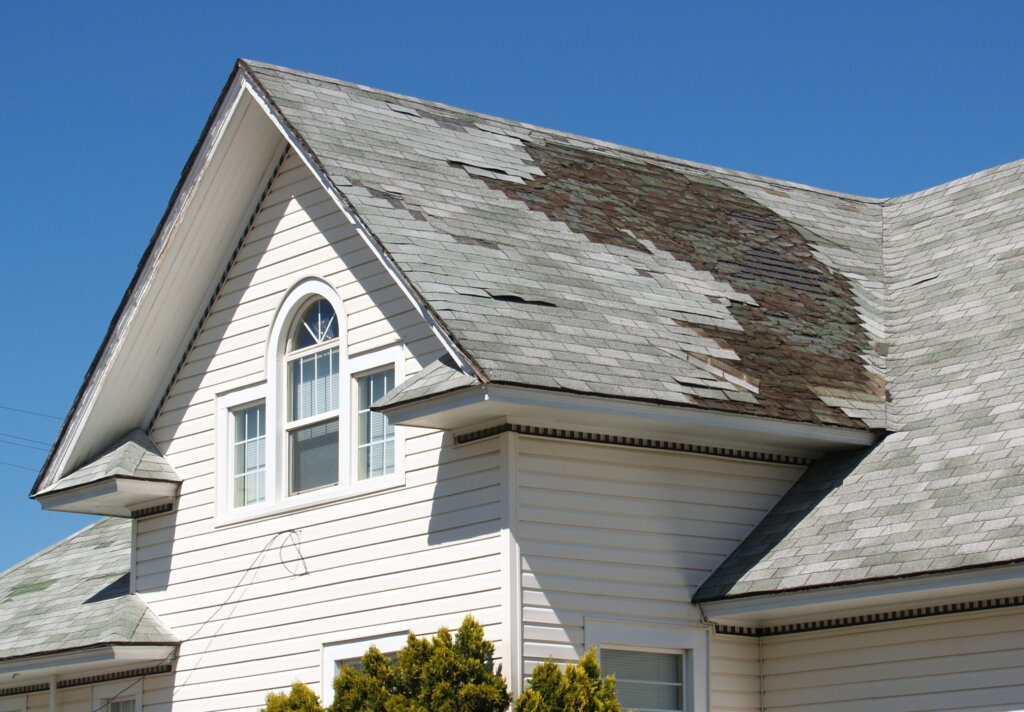
- missing or damaged shingles;
- failed flashing;
- problems around vents or chimneys;
- storm damage;
- deteriorated roof decking;
- a localized leak;
- or condensation or another moisture source being mistaken for a roof leak.
Before assuming you need a complete replacement, get enough information to determine whether the problem is:
- a small localized repair;
- one damaged section;
- an active leak requiring prompt attention;
- damaged decking or structural components;
- or widespread roof deterioration.
That distinction matters.
A homeowner can spend more than necessary by replacing an entire roof when the problem is limited. The opposite mistake is also possible: repeatedly patching isolated symptoms while a larger roofing problem continues.
The first useful question is not:
“How much does a new roof cost?”
It is:
“Do I actually need a new roof?”
Repair the Roof or Sell As-Is? Ask These Four Questions
1. Is the damage isolated or widespread?
A few damaged shingles are different from repeated leaks in several rooms.
Before choosing how to sell, determine whether you are dealing with a minor repair, widespread material failure, deteriorated decking, visible sagging, repeated water intrusion, or possible structural damage.
When the roof is only one part of a larger repair burden, evaluate the whole property rather than looking at the roofing project by itself.
A house that also needs plumbing work, HVAC replacement, foundation repairs, electrical updates, or extensive cleanup creates a different financial decision than an otherwise market-ready home with one isolated roof issue.
2. Has water reached the interior?
Once water gets beyond the roofing system, the problem may extend to:
- insulation;
- ceilings;
- drywall;
- roof sheathing;
- framing;
- or other materials.
Do not assume every ceiling stain means extensive hidden damage. At the same time, do not approve a major roofing project or choose a selling strategy without considering whether anything below the roof has also been affected.
A professional evaluation can help separate a limited roof repair from a larger water-intrusion problem.
3. Is the roof the only major problem?
Putting money into the roof may make sense when the rest of the property is ready for the market.
The calculation changes when the house also needs:
- HVAC replacement;
- plumbing work;
- electrical repairs;
- foundation work;
- extensive cleanout;
- water-damage repairs;
- or years of deferred maintenance.
When several projects are competing for the same budget, compare the likely cost and benefit of the entire repair plan, not only the roof.
For homeowners dealing with several condition problems at once, our guide to selling a distressed property in Fort Wayne explains the broader options available.
4. What matters more: maximum market exposure or avoiding another project?
A homeowner with money available and plenty of time before moving may reasonably decide to repair and list.
An out-of-state heir managing a vacant property may reach a different conclusion. So might a landlord who has already decided to sell and does not want to manage another renovation.
Neither choice is automatically better.
Compare:
- repair costs;
- holding expenses;
- transaction expenses;
- time;
- contractor management;
- uncertainty;
- and likely net proceeds.
The right decision depends on your actual property and priorities, not on a one-size-fits-all rule.
Your Main Options for Selling a House with a Bad Roof
Option 1: Repair or Replace the Roof Before Listing
Repairing before listing may make sense when:
- the rest of the house is in good condition;
- you have sufficient funds;
- the work is likely to improve marketability;
- you have time to coordinate the project;
- and broad market exposure is important to you.
The potential advantage is straightforward: buyers have one less major property concern to evaluate.
The limitation is that money spent before a sale is not guaranteed to return dollar for dollar.
Before approving a large project, compare the expected sale result after repairs with:
- the cost of the roofing work;
- any interior repairs;
- the time needed to complete the project;
- and additional holding expenses while the house remains unsold.
Homeowners planning roofing work should also verify local requirements before construction begins. According to Allen County’s homeowner project guidance, re-roofing is listed as an example of a project requiring a permit.
Option 2: Make a Limited Repair
The decision is not always “do nothing” or “replace everything.”
Depending on the actual problem, a homeowner may decide to:
- stop an active leak;
- repair one damaged section;
- replace failed flashing;
- or complete emergency work to prevent additional water intrusion.
This approach may make sense when the problem has been clearly diagnosed and is genuinely limited.
The key is to diagnose first rather than assume that a patch is enough—or that complete replacement is necessary.
Option 3: List the House in Its Current Condition
Some homeowners choose to market a property without replacing the roof first.
That can work, but the pricing and selling strategy should reflect the actual condition of the house.
Roof damage can affect:
- buyer interest;
- pricing;
- inspection negotiations;
- insurance questions;
- and practical financing considerations in some transactions.
Selling in current condition should not be confused with ignoring known property information.
Indiana’s official Seller’s Residential Real Estate Sales Disclosure form includes roof-specific questions about roof age if known, known roof leaks, present roof damage, and multiple layers of shingles. Indiana’s residential disclosure rules generally require covered owners to complete the disclosure before an offer is accepted, although transaction-specific exceptions may apply.
Homeowners who are unsure about their legal obligations should speak with a qualified Indiana real estate attorney or another appropriate professional.
Option 4: Negotiate Around the Roof Problem
In some traditional transactions, the roof becomes part of the negotiation.
Depending on the property, contract, buyer, and financing situation, the parties may discuss:
- a different purchase price;
- seller-completed work;
- contractual concessions;
- or other written terms.
Do not assume that a credit automatically solves every roof-related issue. A particular lender, insurer, appraisal, or contract may affect what is workable in a specific transaction.
The better question is not simply:
“Which option gives me the highest sale price?”
Ask:
“Which option gives me the best realistic result after considering money, time, work, contingencies, and risk?”
Option 5: Compare a Direct As-Is Sale
A direct sale may be worth comparing when the homeowner does not want to manage roofing work before selling.
For example:
- the seller does not want to fund repairs;
- the roof is one of several major problems;
- the property is vacant;
- the owner lives outside Indiana;
- the house needs significant cleanout;
- or coordinating contractors is impractical.
A direct sale is not automatically the best choice.
Before accepting an offer, compare the written terms, including:
- purchase price;
- earnest money;
- inspection or due-diligence rights;
- cancellation provisions;
- assignment language;
- closing date;
- property access;
- cleanout responsibilities;
- and transaction expenses.
Indiana Home Solutions LLC’s How It Works page explains the company’s direct-sale process and how it evaluates properties that need repairs.
Why Roof Damage Matters in Fort Wayne
Fort Wayne experiences regular thunderstorms, winter snowfall, and occasional severe weather.
The National Weather Service Fort Wayne climate summary reports an average of 39 thunderstorm days per year, with most occurring from May through August.
Severe storms can also bring high winds and hail. For example, the National Weather Service’s summary of the June 18, 2025 event documented estimated wind gusts of 50–60 mph, quarter- to golf-ball-size hail in Northeast Indiana, and some roof and siding damage across the broader forecast area.
That local context matters because roof problems can have very different causes:
- recent storm damage;
- aging materials;
- delayed maintenance;
- failed flashing;
- or water intrusion that went unnoticed.
Vacant and inherited houses deserve particular attention because leaks may continue without an occupant noticing new damage.
Owners managing an empty property can also read our guide to selling a vacant house in Fort Wayne.
What If the Roof Damage May Be Storm-Related?
If wind, hail, ice, or another weather event may have caused the problem, document what you can safely see and review your insurance situation.
Useful steps may include:
- Photograph visible damage from safe locations.
- Record when you first noticed the problem.
- Save estimates and emergency-repair invoices.
- Review your insurance policy.
- Contact your insurer or agent about the claims process.
- Keep notes from important conversations.
Do not climb onto a damaged, wet, icy, or structurally questionable roof to take pictures.
The Indiana Department of Insurance advises homeowners dealing with property damage to contact the insurer or agent, photograph the damage, take necessary temporary measures to prevent further loss, and save relevant receipts. The department also notes that coverage depends on the cause of loss and policy terms.
Step-by-Step: Preparing a Roof-Damaged House for Sale
Step 1: Prevent Additional Damage When Safe
An active leak should not be ignored while you spend weeks deciding how to sell.
Take reasonable steps to prevent additional water intrusion without putting yourself at risk. Keep invoices, photographs, contractor information, and insurance correspondence.
Step 2: Understand the Scope
Get enough information to distinguish among:
- localized repair;
- partial replacement;
- full replacement;
- decking damage;
- structural concerns;
- and secondary interior damage.
A useful estimate gives you something concrete to compare with selling in the property’s current condition.
Step 3: Gather Existing Records
Look for:
- previous roofing invoices;
- warranties;
- inspection reports;
- repair estimates;
- permit records;
- insurance correspondence;
- and photographs.
You may not have every document. The goal is to work from information that actually exists instead of guessing.
Step 4: Calculate More Than the Roof Estimate
A roofing estimate alone does not answer whether repairing before selling is the better decision.
Also consider:
- interior repairs;
- other property work;
- cleaning;
- utilities;
- insurance;
- property taxes;
- mortgage payments;
- yard maintenance;
- cleanout expenses;
- transaction expenses;
- and the time needed to complete the project.
The important comparison is expected net proceeds and total effort, not only the projected sale price.
Step 5: Compare Realistic Selling Routes
For many homeowners, the realistic choices are:
- repair and list;
- make limited repairs and list;
- market the house in its current condition;
- compare a direct as-is sale.
The right answer can differ for two houses with similar roof damage because the owners’ finances, timelines, and other property problems may be completely different.
Repair, List As-Is, or Sell Directly?
| Factor | Repair Before Listing | List in Current Condition | Direct As-Is Sale |
|---|---|---|---|
| Upfront repair spending | Can be significant | Lower if repairs are deferred | Usually lower if buyer accepts current condition |
| Contractor management | Usually required | May be limited | Usually reduced |
| Market exposure | Broad | Broad, but condition affects demand | Limited to buyers approached |
| Buyer pool | Potentially broader | May be narrower | Buyers comfortable with repair needs |
| Property preparation | Often more extensive | Varies | Usually less extensive |
| Seller workload | Higher during repairs | Moderate | Usually lower |
| Best fit | Owner with time, funds, and repair upside | Owner willing to market a fixer-upper | Owner prioritizing simplicity and avoiding pre-sale work |
There is no universally best option. Compare real estimates, written offers, likely net proceeds, and the amount of work required.
Fort Wayne Example: Selling an Inherited House with a Roof Leak
The following example is hypothetical and is not based on an actual Indiana Home Solutions LLC transaction.
Suppose two siblings inherit an older Fort Wayne house.
Neither lives nearby. The property has been vacant for several months, and during a visit they notice a ceiling stain in an upstairs bedroom. Several shingles are missing, and nobody knows when the roof was installed.
A practical process would be to:
- confirm who has legal authority to sell;
- get the roof evaluated;
- determine whether the leak affected the interior or structure;
- locate available insurance and repair records;
- compare repair costs with realistic selling options;
- obtain written estimates or offers;
- compare expected net proceeds.
If the roof is the only serious issue and the property can become market-ready with manageable work, repairing before listing may deserve serious consideration.
If the roof problem is part of a longer list—old mechanical systems, interior water damage, extensive cleanout, and years of deferred maintenance—selling in the current condition may be worth comparing.
Owners facing that situation can also read our guide on what to do after inheriting a house in Fort Wayne.
Common Mistakes to Avoid
Replacing the Entire Roof Before Confirming the Problem
A roof may need replacement, but do not assume that from one ceiling stain or a quick look from the ground.
Find out what is actually damaged first.
Ignoring an Active Leak While Deciding
A selling decision may take time. Water intrusion can continue during that period.
Take reasonable steps to understand and stabilize the problem when safe and practical.
Assuming “As-Is” Means Known Conditions Do Not Matter
Selling in current condition should not be treated as a substitute for understanding applicable disclosure obligations.
Indiana’s official disclosure form contains specific questions related to roof leaks and roof condition.
Looking Only at the Sale Price
A higher price does not always produce a better net result.
Consider repairs, holding expenses, transaction costs, contingencies, time, and the amount of work involved.
Treating the Roof as the Only Problem
When the property also has HVAC, plumbing, foundation, water-damage, or cleanout issues, evaluate the whole house.
Fixing one major problem may not make sense if several others remain.
Frequently Asked Questions About Selling a House with Roof Damage
Can you sell a house that needs a new roof in Fort Wayne?
Yes. You can sell a Fort Wayne house without replacing the roof first. Depending on the damage and your goals, you may repair it, list the property in its current condition, or compare an as-is sale.
Should I replace my roof before selling my house?
Not always. Replacing the roof may make sense if the rest of the house is market-ready and the improvement is likely to justify the cost. Selling without replacement may be better when the roof is one of several major repairs.
Can I sell a house with a leaking roof in Fort Wayne?
Yes. A leaking roof does not prevent a Fort Wayne house from being sold. First, determine whether the issue is a small repair or part of a larger problem involving decking, interior water damage, or structural concerns.
Will buyers purchase a house with a bad roof?
Yes, some buyers will. However, a bad roof can affect pricing, negotiations, inspections, financing, and buyer interest. Traditional buyers, investors, renovation buyers, and direct cash buyers may evaluate the same property differently.
How does roof damage affect the selling price of a house in Fort Wayne?
There is no fixed percentage. The effect depends on the severity of the damage, repair costs, secondary water damage, overall property condition, buyer demand, and the method used to sell the house.
Does Indiana require sellers to disclose known roof problems?
Indiana’s official residential seller disclosure form includes questions about known roof leaks, present roof damage, roof age if known, and multiple layers of shingles. Some transactions may be treated differently, so sellers with questions should review the current form and seek qualified legal advice.
What if a roof leak has already caused water damage inside the house?
Find out how far the damage extends before choosing how to sell. A roof leak may affect insulation, ceilings, drywall, sheathing, framing, or other materials. The repair scope should be evaluated rather than guessed.
Can I sell a house with storm or hail damage in Fort Wayne?
Yes. A storm- or hail-damaged house can be sold. Document the condition, determine the extent of the damage, and review your insurance policy. If the damage may be covered, contact your insurer or agent about the claims process.
Is selling to a cash buyer better than replacing the roof and listing?
Not always. Repairing and listing may be better when the house is otherwise market-ready and broad market exposure is the priority. An as-is sale may be worth comparing when avoiding repairs, contractor management, and property preparation matters more.
Not Sure Whether the Roof Is Worth Fixing Before You Sell?
Before writing a check for a major roofing project, compare the numbers for the choices that are actually available to you.
For some Fort Wayne homeowners, repairing the roof and listing will make the most sense. For others—especially when the roof is one of several expensive property problems—selling in the current condition may be worth considering.
Indiana Home Solutions LLC can evaluate the property and explain what a direct cash purchase would look like. There is no obligation to accept an offer, so you can compare the price and terms with the cost and work involved in your other selling options.
You can also review how the home-buying process works before deciding whether a direct sale belongs in your comparison.